
The Road Ahead
July 13, 2026
The short version
Just as Middle East supply lines were beginning to loosen, a fresh round of U.S. and Iran hostilities has put the recovery back in question. For lubricant buyers, the practical takeaway is unchanged from the last several months: supply, not price alone, remains the real constraint, particularly on the synthetic (Group III) side.
What Happened
After weeks of cautious optimism, with more vessels transiting the Strait of Hormuz, a signed memorandum of understanding, and producers preparing to restart idled units, the situation reversed early this month. Iranian drone strikes on commercial tankers in the strait, including an LNG carrier, prompted U.S. retaliatory action. In the immediate aftermath, the administration pulled the waiver permitting sales of Iranian crude, and Iran reaffirmed its intent to control traffic through the strait.
Crude reacted the way you would expect. West Texas Intermediate has climbed into the mid-$70s with Brent hovering around the $80 mark, both grinding higher as each headline crosses. The concern is less about where crude sits today and more about whether this interrupts the supply restart that so much of the market had been counting on.
Base Oil Supply: Still the Bottleneck
The core problem has not changed. With cargoes unable to leave the Persian Gulf, the barrels the global market normally leans on simply are not moving.
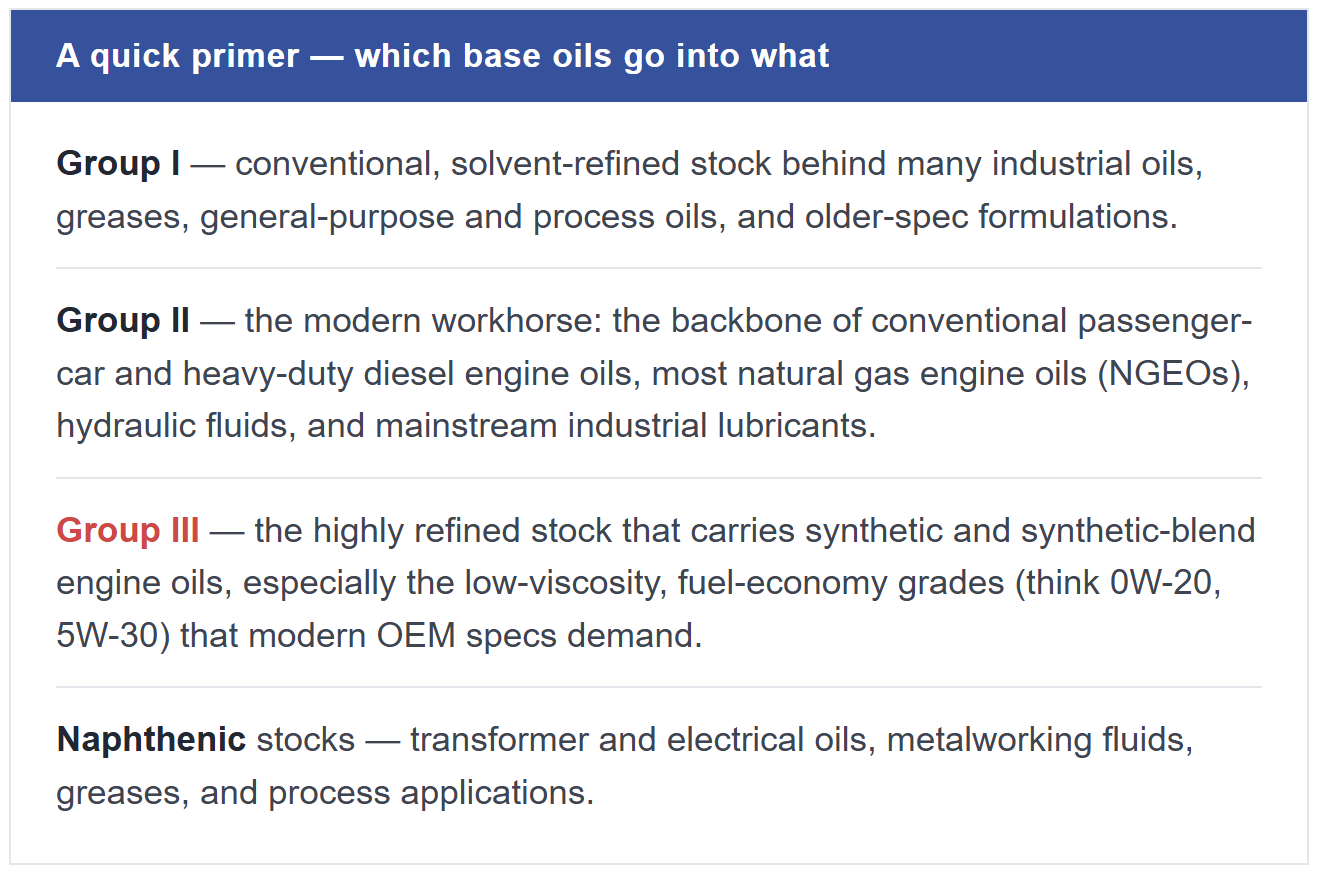
That hierarchy is why the pain is not evenly distributed; the tightest segment is also the one feeding the newest, highest-spec products.
Group III (synthetics) remains the tightest and most exposed segment, and it is the one behind full-synthetic and synthetic-blend motor oils, so the crunch lands hardest on the modern, OEM-spec passenger-car and newer heavy-duty grades. Middle East production accounts for a very large share of U.S. Group III demand, and that gap cannot be closed overnight. Several Gulf producers had begun restarting output during the brief ceasefire window, but at least one major facility damaged earlier this year is not expected back at full capacity for months. Suppliers in Asia and Canada are working to fill the void, but the available volume does not fully bridge the shortfall. Even in the best case where transits resume safely, the first replenishment cargoes are not expected to land until late summer. Re-refined Group III has absorbed some demand, to the point that re-refiners have run short as well.
Group I and Group II production here at home has continued to run largely uninterrupted, which is the good news, and since Group II underpins most conventional engine oils, hydraulics, and industrial lubricants, that stability matters for the bulk of everyday products. For the natural gas engine oils (NGEOs) many of you run in field compression and power generation, that is meaningful: conventional low-ash and ashless NGEOs are built largely on Group I and Group II stock, so the workhorse grades sit on the steadier side of this market. The exception is premium synthetic NGEOs like synthetic motor oils; they lean on Group III (and, in some full-synthetic grades, PAO), so they carry the same tightness as the rest of the synthetic slate. The complication: with Group III scarce, many blenders have shifted toward Group II, especially the light grades wherever formulations allow. The catch is that Group II cannot always stand in for Group III; the higher-VI synthetic grades often require properties only Group III delivers, which is why substitution goes only so far. That shift has tightened Group II in turn, and light grades are now the snuggest part of that segment. Most suppliers have suspended spot offers and are focused on honoring contracts. Scheduled turnarounds and thin inventories heading into hurricane season add another layer of caution. Heavy grades and bright stock, the heavier cuts used in gear oils, greases, and some industrial and marine products, remain hard to find, with limited spot volume available.
Naphthenic base oils have held steadier, though producers are watching Brent closely, since it moves these grades more directly than the paraffinics. These are the stocks behind transformer and electrical oils, metalworking fluids, and various process applications. Light pale grades have tightened, partly on strong transformer-oil demand and partly as some industrial users substitute pale oils for scarce paraffinic cuts.
The Outlook
The honest assessment: even if the strait were fully reopened tomorrow, the effects of these disruptions would likely be felt well into next year. New domestic Group III capacity is on the horizon; additional volume is expected to reach the market later this year, with a larger expansion further out but nothing that changes the near-term math.
On the fundamentals, the U.S. Energy Information Administration’s July Short-Term Energy Outlook points lower. It has Brent averaging roughly $74/bbl in the third quarter and easing toward a $65/bbl average in 2027, on the expectation that shut-in production comes back online and the market tips back toward the oversupply it was in before the conflict. The EIA also sees full-year U.S. crude output edging up to around 13.8 million barrels per day, and on the fuel side, retail gasoline easing from north of $4.20/gal earlier this year toward the mid-$3 range by the fourth quarter, with diesel tracking crude lower.
One important caveat on those EIA numbers: that outlook was completed on July 1 before this month’s renewed strikes, so it reflects a “conflict settles down” baseline. Read it as where the fundamentals point once the geopolitical noise clears, not as a call on the next few weeks. The near-term risk is still to the upside if hostilities drag on, which is exactly why current spot crude is grinding higher even as the forward view softens.
For now, availability continues to matter more than price. Lead times, allocations, and formulation flexibility are the levers most worth paying attention to. We are monitoring the situation daily and will keep you posted as conditions develop.
As always, if you have questions about how any of this affects your specific products or programs, reach out; we are happy to talk it through.

SHARE THIS